Navratri Day 2: Maa Brahmacharini, the Flame of Ascetic Resolve
On the second night of Navratri, the divine feminine transforms from the sheltered daughter of the peaks into the fierce, solitary ascetic. Maa Brahmacharini—literally "one who practices Brahma-charya (unwavering absorption in supreme truth)"—personifies the spiritual crucible of discipline, self-denial, and relentless purpose.
The story
After resolving to unite with Lord Shiva, Parvati sought guidance from Sage Narada. The sage explained that the Great Ascetic, consumed in cosmic meditation upon the funeral pyres, could never be wooed by worldly beauty or royal wealth; he could only be reached through equal depth of Tapasya (spiritual austerity).
Leaving her royal palace behind, Parvati discarded her jewelry, donned rough bark garments, and retreated into the dense Himalayan wilderness. According to the Shiva Purana, for one thousand years she survived solely on fallen roots and wild fruits; for the next three thousand years, she sustained herself only on leaves. Eventually, she renounced even fallen leaves, earning the revered title Aparna ("without leaf"), subsisting solely on atmospheric prana and melting snow.
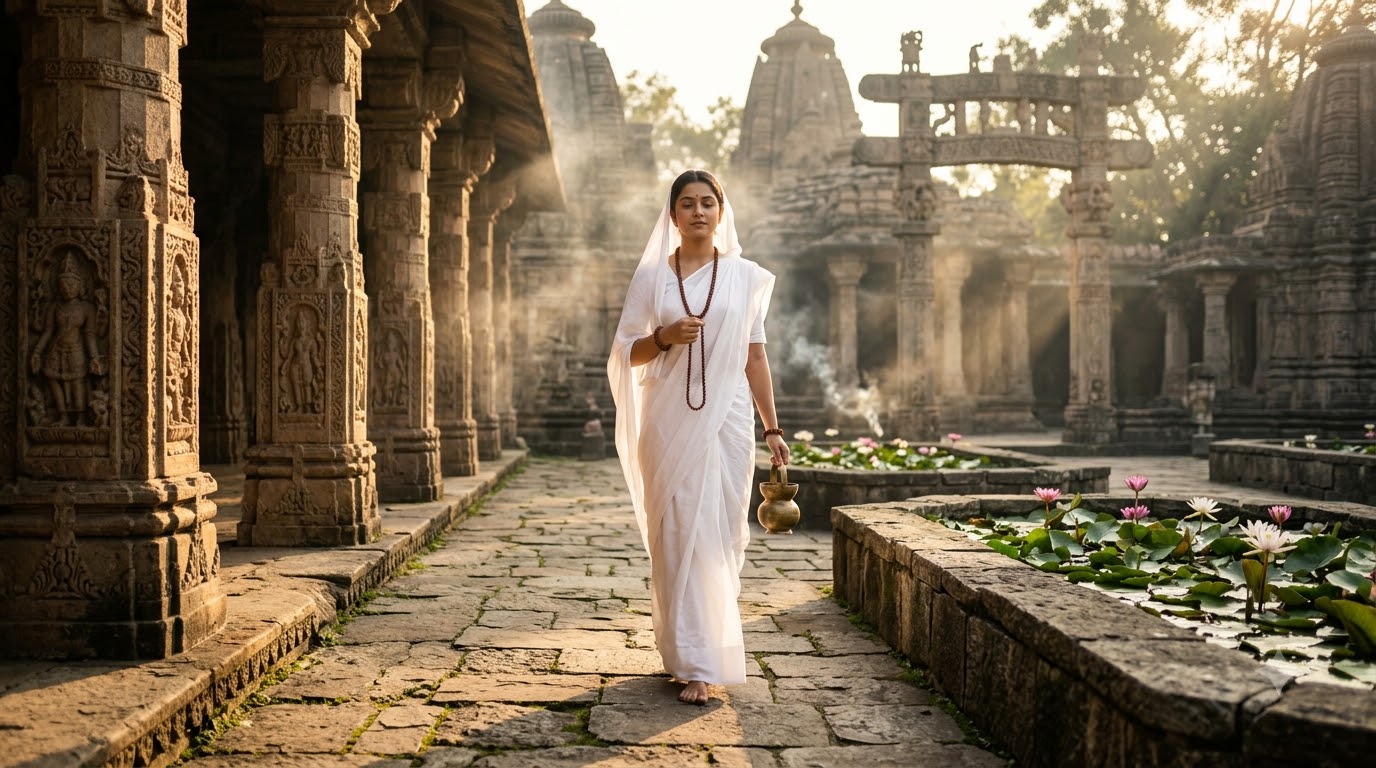
Her extraordinary penance scorched the realms with internal heat (Tapas), causing celestial beings to marvel at her endurance. Ultimately, her unwavering focus compelled Shiva to break his cosmic trance and accept her as his spiritual equal.
दधाना करपद्माभ्यामक्षमालाकमण्डलू।
देवी प्रसीदतु मयि ब्रह्मचारिण्यनुत्तमा॥

Translation: Holding in her lotus hands the sacred rosary of meditation beads and the water-pot of life, may the incomparable Goddess Brahmacharini bestow her tranquil grace upon me.
Iconography and philosophical symbolism
Brahmacharini’s iconography is deliberately stripped of regal or violent accoutrements:
- Barefoot Simplicity: She rides no beast and wears no weapons. Walking barefoot upon uneven ground represents direct, unmediated contact with the soil of reality.
- The Akshamala (Japa Beads): Held in her right hand, the string of beads symbolizes repetition, single-pointed concentration, and the mastery of wandering thoughts.
- The Kamandalu (Water Vessel): In her left hand, the water pot represents self-containment, purity, and the reservoir of spiritual energy conserved through disciplined senses.
- Swadhisthana Chakra: She governs the Sacral Chakra, the psychological seat of desire, creativity, and sensory temptation. By turning desire away from fleeting gratification toward transcendent realization, Brahmacharini demonstrates the sublimation of primal passion into luminous willpower.
What the evidence shows
From a socio-religious perspective, Brahmacharini represents an extraordinary exception within classical ancient Indian literature: the autonomous female ascetic (Tapasvini).
In orthodox Vedic and Dharmashastric texts (such as the Manusmriti), the formal stages of life (Ashramas), particularly ascetic renunciation (Sannyasa), were largely codified for upper-caste males, while women's spiritual duties were predominantly framed within domestic (Grihastha) obligations. The mythology of Brahmacharini firmly establishes feminine agency in extreme ascetic practices, asserting that the pursuit of ultimate reality is completely independent of gender.
Where experts disagree
Scholars debate the origins of the tapasya narrative in the Parvati cycle. Indologists like David Kinsley suggest that the severe austerities attributed to Parvati were designed to bridge the chasm between two fundamentally conflicting theological schools: orthodox household Vedic religion and heterodox, non-Vedic ascetic movements (such as the Pashupatas and Kapalikas).
By having the mother goddess undergo identical mortifications as Shiva himself, Puranic compilers unified the wild, marginal ascetic traditions with broader Hindu domestic piety.
What we still don't know
We do not know whether the Tapasvini archetype was derived from historical female renunciants who practiced in Himalayan forests or if it was formulated primarily as literary allegory. While Buddhist and Jain records explicitly chronicle early orders of female ascetics, early Brahmanical records remain largely silent on institutional orders for women.
Sources
- Kinsley, David. Hindu Goddesses: Visions of the Divine Feminine in the Hindu Religious Tradition. University of California Press, 1988.
- Coburn, Thomas B. Encountering the Goddess: A Translation of the Devi-Mahatmya. State University of New York Press, 1991.
- Doniger, Wendy. Siva: The Erotic Ascetic. Oxford University Press, 1981.
Evidence Labels
More like this
Navratri Day 1: Maa Shailaputri, the Mountain Daughter and Root Consciousness
The first night of Navratri honors Shailaputri: daughter of the Himalayas, rider of the bull Nandi, and embodiment of Muladhara root energy.
Navratri Day 3: Maa Chandraghanta, the Resonance of Vigilant Courage
The third night of Navratri honors Chandraghanta: the bell-adorned warrior mounted on a tiger, uniting serenity with militant readiness.