Navratri Day 1: Maa Shailaputri, the Mountain Daughter and Root Consciousness
The nine-night sequence of Navratri begins not with a warrior brandishing celestial weapons, but with a daughter returning to the physical earth. Maa Shailaputri—literally "Daughter of the Mountain"—personifies the foundational emergence of conscious energy (Prakriti) from the raw bedrock of the Himalayas.
The story
Following the catastrophic tragedy of Daksha’s sacrifice where Sati immolated herself in defense of Shiva's honor, the cosmic energy withdrew from manifest creation. According to the Shiva Purana and Kalika Purana, she reincarnated as the daughter of Himavat (the personified king of the Himalayas) and Queen Menavati.
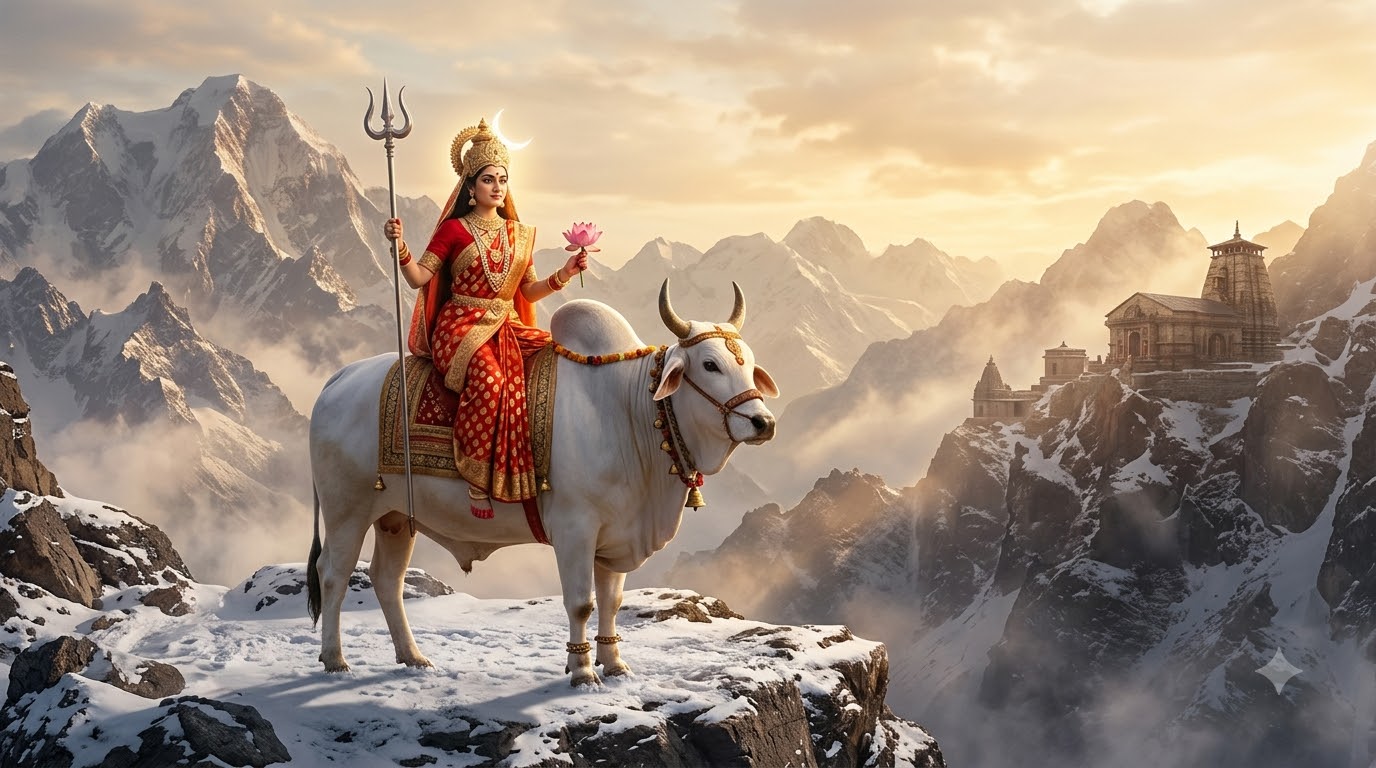
Named Parvati ("of the mountain") or Shailaputri, her birth signified the return of divine feminine consciousness to the physical realm. Her childhood in the snowy peaks represents the awakening of latent spiritual determination: she instinctively sought the desolate, ascetic Shiva meditating upon Mount Kailash, initiating the epic journey of reunion that anchors Shakta mythology.
वन्दे वाञ्छितलाभाय चन्द्रार्धकृतशेखराम्।
वृषारूढां शूलधरां शैलपुत्रीं यशस्विनीम्॥

Translation: I bow to the illustrious Goddess Shailaputri, who is adorned with a crescent moon, rides upon the bull Nandi, and holds a trident, for the fulfillment of all noble aspirations.
Iconography and philosophical symbolism
Every iconographic element associated with Shailaputri points toward stability, primal power, and physical groundedness:
- The Bull (Vrishabha / Nandi): Her mount is the bull, a symbol of brute strength, patient labor, and righteous conduct (Dharma). Seated upon the bull, the Goddess demonstrates mastery over animalistic instinct and physical inertia.
- The Trident (Trishula): Carried in her right hand, the trident represents sovereignty over the three states of time (past, present, future) and the three Gunas (Sattva, Rajas, Tamas).
- The Lotus (Padma): In her left hand, the water-born lotus blooms untouched by mud, representing the possibility of spiritual enlightenment rising through material existence.
- Muladhara Chakra: In yogic physiology, Shailaputri presides over the Root Chakra at the base of the spine. Just as a mountain anchors the earth, the Muladhara provides the unshakeable foundation for the rising serpent energy (Kundalini).
What the evidence shows
Textual and ethnographic studies indicate that the figure of Shailaputri represents the historical syncretism between ancient Himalayan mountain cults and pan-Indian Brahmanical theology.
In early animistic traditions across the Himalayan belt, peaks and rivers were worshipped as autonomous, living maternal entities. Anthropologists observe that when classical Puranic literature codified the Goddess tradition around the 5th to 8th century CE, these fiercely local mountain spirits were harmonized into the overarching framework of the Devi Mahatmya as the primal daughter of Himavat.
Where experts disagree
Religious historians debate whether Shailaputri was originally an independent regional goddess who was gradually subordinated into the Shiva mythos as a consort, or whether her character was formulated specifically to reconcile ascetic Shaivism with householder Shakta ritualism.
Textual scholars point out that in the Rigveda (10.125, the Devi Sukta), the supreme feminine power speaks as cosmic speech (Vak) without geographic confinement. In contrast, the later Puranas ground her deeply in Himalayan geography, which some scholars interpret as a medieval political strategy to integrate mountain tribal populations into mainstream temple culture.
What we still don't know
We do not have historical documentation for the exact period when the nine distinct forms of Navadurga were formalized into the autumn calendar. While the Devi Kavacha (associated with the Chandi Patha) lists Shailaputri as the first avatar, archaeological remains of independent Shailaputri shrines prior to the early medieval era remain scarce.
Sources
- Coburn, Thomas B. Devi Mahatmya: The Crystallization of the Goddess Tradition. Motilal Banarsidass, 1988.
- Kinsley, David. Hindu Goddesses: Visions of the Divine Feminine in the Hindu Religious Tradition. University of California Press, 1988.
- Shastri, J. L. (Ed.). The Siva-Purana. Motilal Banarsidass, 1970.
Evidence Labels
More like this
Navratri Day 2: Maa Brahmacharini, the Flame of Ascetic Resolve
The second night of Navratri honors Brahmacharini: the barefoot seeker who practiced millennia of solitary penance to awaken consciousness.
Maa Durga and the Nine Avatars: Symbolism of the Divine Feminine
An exploration of the Navadurga, the warrior goddess archetype, and her triumph over Mahishasura.