Navratri Day 3: Maa Chandraghanta, the Resonance of Vigilant Courage
On the third night of Navratri, the quiet penance of the forest gives way to militant vigilance. Maa Chandraghanta—named for the half-moon on her forehead shaped like a heavy bronze temple bell (Ghanta)—embodies the synthesis of absolute serenity and immediate warrior readiness.
The story
The mythological emergence of Chandraghanta occurs at the wedding of Shiva and Parvati. When Lord Shiva arrived at King Himavat’s palace to claim his bride, he arrived in his raw, terrifying form: smeared in funeral ashes, adorned with live venomous serpents, draped in tiger skins, and accompanied by a wild entourage of ghosts, goblins (ganas), and ascetics.
Seeing this terrifying spectacle, Parvati’s mother Menavati fainted in sheer horror, and chaos engulfed the royal assembly.
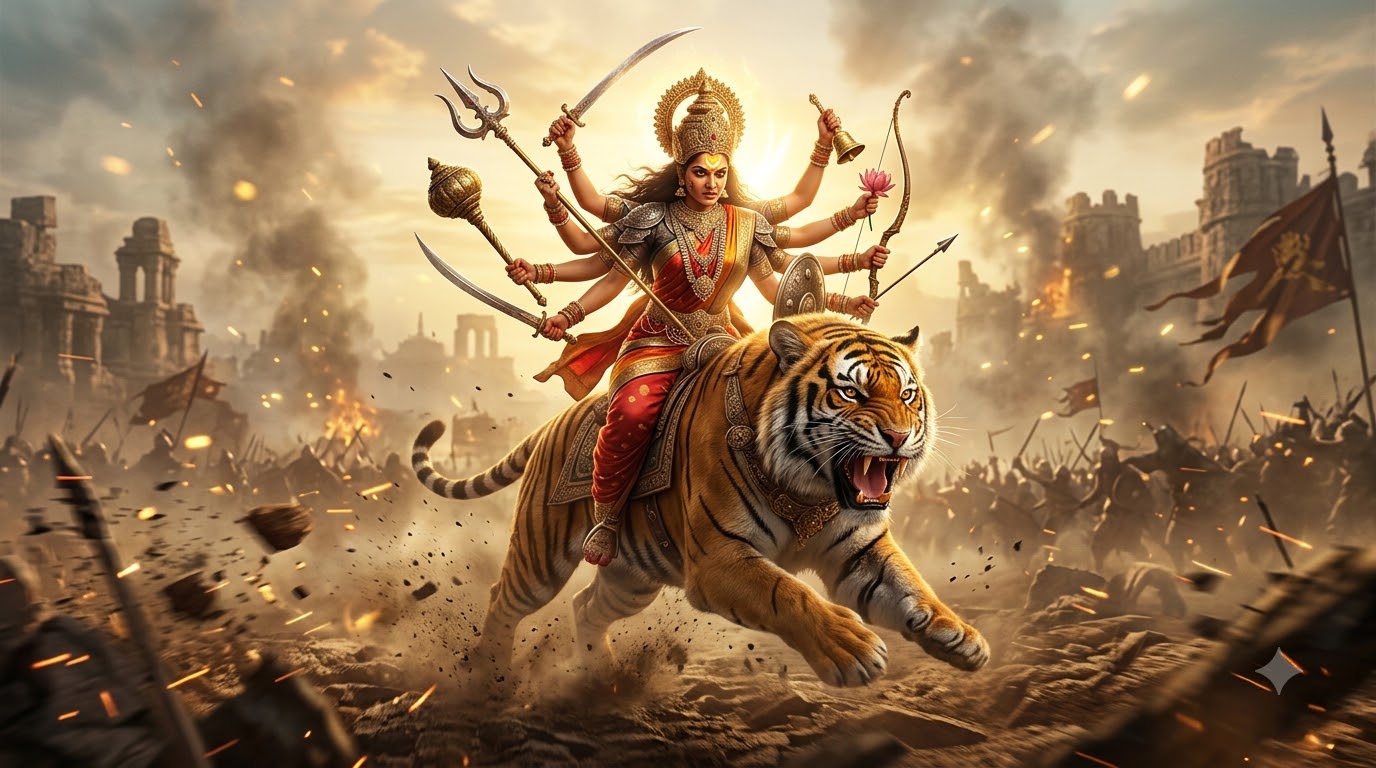
To prevent disaster and restore balance, Parvati instantly transformed herself into the formidable, golden-hued Chandraghanta. Mounted upon a ferocious tigress, armed with ten weapons, and ringing the resonant bell on her brow, she matched Shiva’s terrifying energy with equal divine grandeur. She approached Shiva with poise, gently requesting him to assume a noble, auspicious form (Sundaramurti). Shiva obliged, transforming into the magnificent Chandrashekhara, and the wedding proceeded in joy.
पिण्डजप्रवरारूढा चण्डकोपास्त्रकैर्युता।
प्रसादं तनुते मह्यं चन्द्रघण्टेति विश्रुता॥

Translation: Mounted upon a formidable tiger, equipped with devastating weapons of righteous wrath, may the renowned Goddess Chandraghanta bestow her protective grace upon me.
Iconography and philosophical symbolism
Chandraghanta’s iconography marks the first appearance of overt military armaments in the Navadurga sequence:
- The Crescent Bell (Chandra-Ghanta): The crescent moon represents mental tranquility and coolness, while the bell represents sound vibration (Nada). The resonant chime of her bell is said to strike panic into demonic delusions while purifying the atmosphere for the sincere seeker.
- The Tigress / Lion: Riding a predator symbolizes total control over primal aggressiveness. Courage is not the absence of ferocity, but the disciplined mastery of it.
- Ten Arms: Bearing both offensive weapons (sword, bow, arrows, mace, trident) and sacred implements (lotus, japa beads, water vessel), she demonstrates the synthesis of worldly defense and spiritual cultivation.
- Manipura Chakra: She presides over the Solar Plexus Chakra (Manipura), the energetic center of digestion, fire, willpower, and physical stamina. When energized, it dissolves lethargy, self-doubt, and fear.
What the evidence shows
In Tantric and Vedic acoustic philosophy, sound is not merely a sensory medium, but the primordial creative matrix (Nada Brahman). The ringing bell (Ghanta) of the Goddess is an ancient ritual tool dating back to early liturgical practices.
Archaeological excavations of early historic Indian sites frequently yield ritual bronze bells used in both Buddhist and Hindu shrines. In Shakta liturgy, the sound of the bell is recognized as a sonic boundary: it dispels negative psychological distractions and demarcates sacred ritual space from profane reality.
Where experts disagree
Religious historians debate the domestic versus martial aspects of the Chandraghanta myth. Some scholars view her primarily as a mediator within the marriage mythos—a daughter diplomatically domesticating the wild mountain ascetic Shiva for the benefit of civilized society.
Conversely, Shakta theologians argue that Chandraghanta represents the psychological threshold of the spiritual aspirant: the point where passive meditation must be fortified with militant resolve to confront internal neuroses and external adversities.
What we still don't know
The exact historical transition of the goddess from a wedding peacemaker to a distinct warrior goddess worshipped on the third day of Sharad Navratri remains uncertain in the archaeological record. While early medieval reliefs depict multi-armed goddesses with crescent crowns, specific inscriptions dedicating shrines exclusively to "Chandraghanta" are relatively rare compared to Mahishasuramardini.
Sources
- Coburn, Thomas B. Devi Mahatmya: The Crystallization of the Goddess Tradition. Motilal Banarsidass, 1988.
- Beck, Guy L. Sonic Theology: Hinduism and Sacred Sound. University of South Carolina Press, 1993.
- Kinsley, David. The Goddesses' Mirror: Visions of the Divine from East and West. State University of New York Press, 1989.
Evidence Labels
More like this
Navratri Day 2: Maa Brahmacharini, the Flame of Ascetic Resolve
The second night of Navratri honors Brahmacharini: the barefoot seeker who practiced millennia of solitary penance to awaken consciousness.
Navratri Day 4: Maa Kushmanda & Adi Shakti, the Primordial Smile that Ignited Creation
Worshipped on Chaturthi, Maa Kushmanda is the primordial solar demiurge who dispelled cosmic darkness with a gentle smile, birthing the Hiranyagarbha.