The Kurukshetra War: Day 17
The story
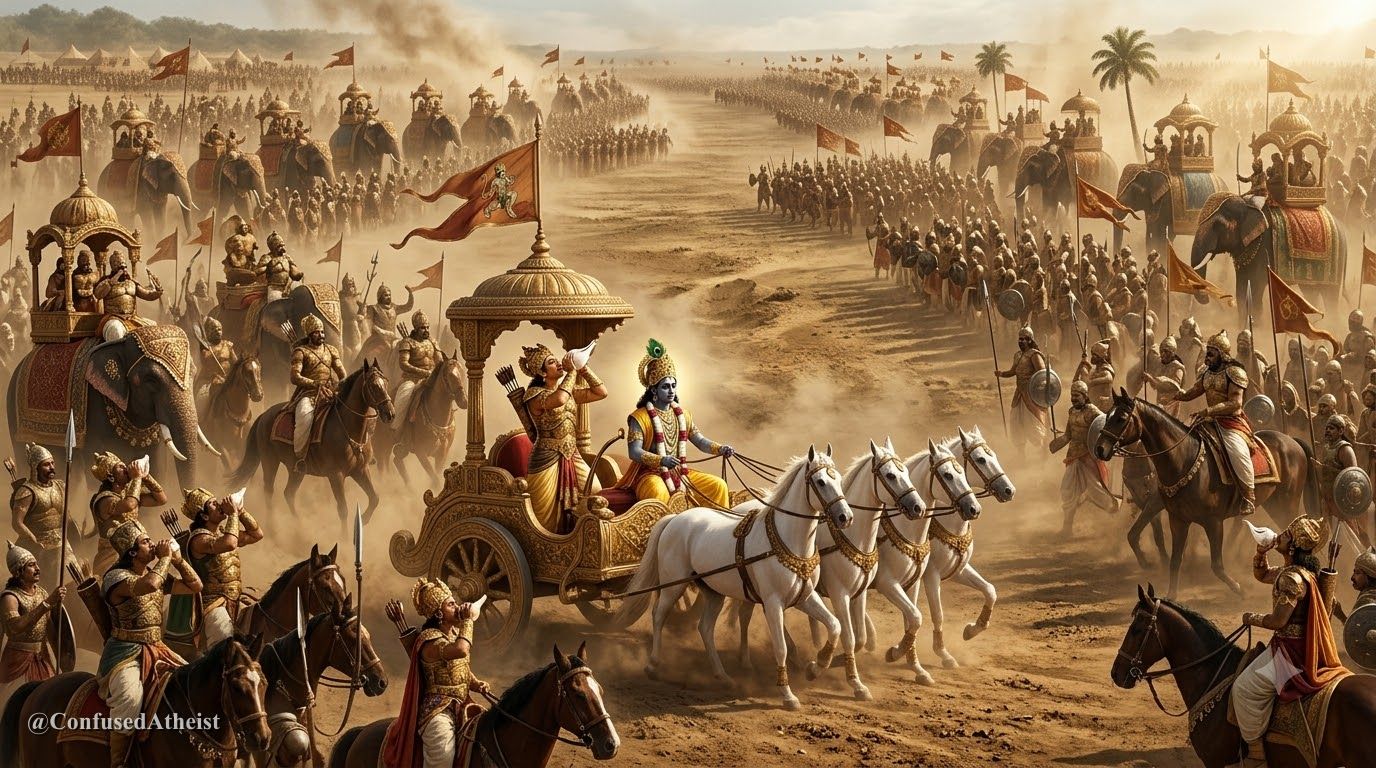
The seventeenth day brought the long-awaited duel between the two greatest archers of their generation: Karna and Arjuna. To match Krishna's skill as Arjuna's charioteer, Duryodhana persuaded King Shalya of Madra to steer Karna's chariot. However, Shalya subtly undermined Karna's confidence throughout the duel, constantly praising Arjuna.
The battle between the two champions shook the plains of Kurukshetra as they traded devastating divine weapons. Karna unleashed the deadly Nagastra aimed at Arjuna's throat; Krishna pressed his foot down upon the chariot, sinking the vehicle five inches into the earth so the missile struck only Arjuna's crown.
The Sunken Wheel and the Final Arrow
At the critical climax of the battle, three ancient curses caught up with Karna simultaneously:
- Under intense stress, he forgot the mantras required to invoke the Brahmastra, as cursed by his preceptor Parashurama.
- The earth opened up and trapped the left wheel of his chariot, fulfilling a curse from an aggrieved Brahmin.
- His celestial armor and earrings (Kavacha and Kundala) had already been yielded to Indra in an earlier act of unyielding generosity.
Stepping down from the chariot into the mud, Karna struggled to lift the heavy wheel, appealing to Arjuna to uphold the code of righteous warfare and halt the engagement while he was disarmed.
Krishna intervened immediately, reminding Karna of every instance where he had participated in the destruction of Dharma: the mocking of Draupadi in the gambling hall, the exile of the Pandavas, and the gang-killing of the unarmed boy Abhimanyu. "Where was your righteousness then, Karna?" Krishna asked.
Urged on by Krishna, Arjuna raised the crescent-shaped Anjalika weapon. With a single release, the arrow struck Karna, ending the life of the tragic warrior whose soul ascended into the radiance of the Sun god Surya.
What we still don't know
Karna remains one of literature's most enduring tragic figures. The epic frames his death not as a simple victory of good over evil, but as a complicated, morally fraught tragedy—where an honorable warrior was bound to an unjust cause by loyalty and caste exclusion.
Sources
- Ganguli, K. M. (1883-1896). The Mahabharata of Krishna-Dwaipayana Vyasa (Karna Parva, Karna-badha Parva).