The Three Arrows of Barbarika: The Warrior Who Could Not Fight
The story
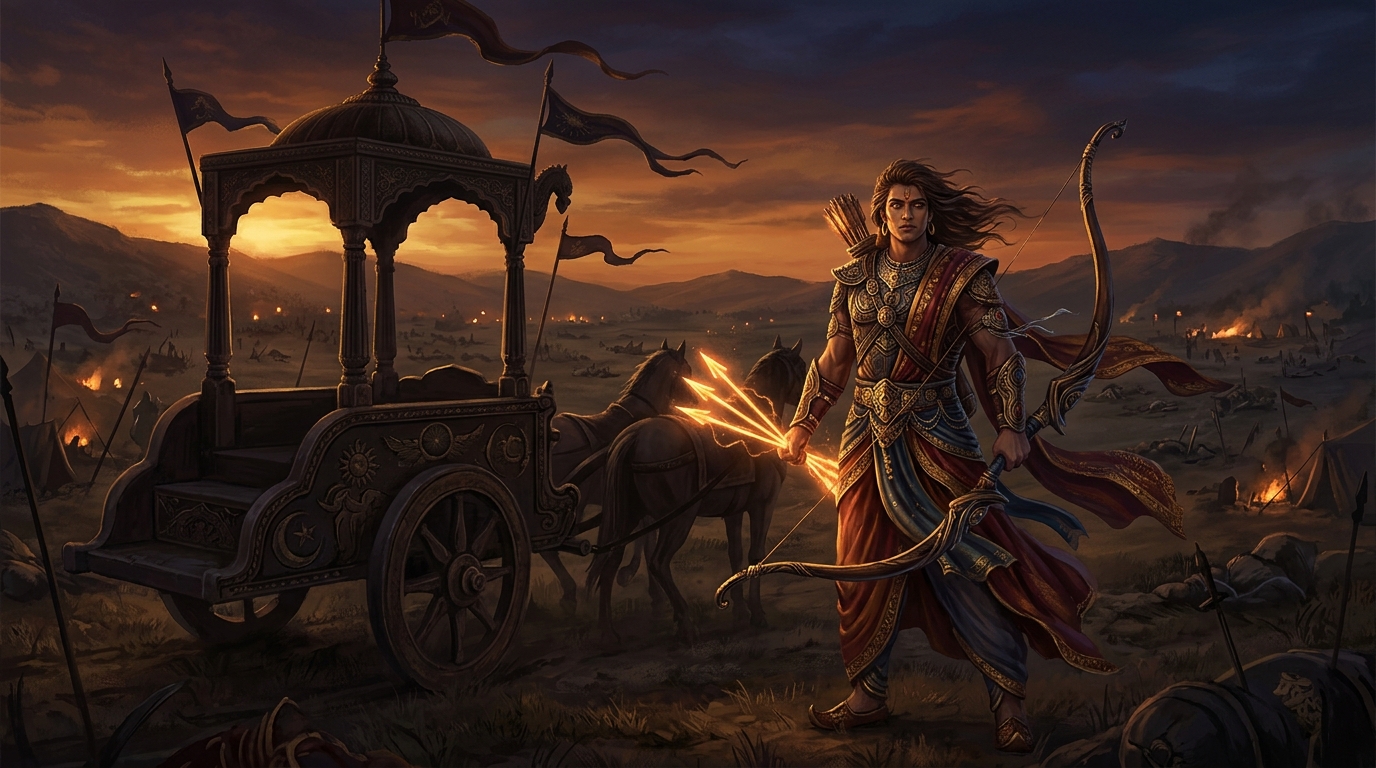
Among the vast catalog of warriors gathered on the plains of Kurukshetra, none carried a stranger destiny than Barbarika, the son of Ghatotkacha and grandson of the mighty Pandava Bhima. According to traditional narratives preserved in the Puranas, Barbarika possessed a divine boon: three infallible arrows (Teen Baan) granted by Lord Shiva and the Goddess.
The first arrow was enchanted to mark every target destined for destruction with vermilion powder. The second arrow marked everything to be protected and spared. The third arrow, once unleashed, would seek out and strike every marked target simultaneously before returning safely to Barbarika's quiver. With just three arrows, an entire army of millions could theoretically be vanquished in seconds.
Before departing for the battlefield, Barbarika’s mother, Maurvi, extracted a solemn vow from him: if he intervened in the war, he had to fight strictly on behalf of whichever side was losing (Hare Ka Sahara).
When Barbarika arrived near Kurukshetra, Krishna disguised himself as a wandering Brahmin to test the youth’s vows. Pointing to a massive peepal tree, Krishna challenged him to pierce every single leaf on the tree with his arrows. Barbarika strung his bow, closed his eyes, and released his first arrow. Red powder marked every leaf on the branches—and then the arrow began hovering insistently above Krishna’s right foot. Unknown to the young warrior, Krishna had secretly stepped on a single fallen leaf to test the weapon. When Krishna lifted his foot, the arrow marked that leaf as well.
Krishna immediately recognized the terrifying mathematical paradox of Barbarika's vow:
If the Pandavas begin to falter, Barbarika must fight for the Pandavas. But his invincible arrows would instantly decimate the Kauravas, suddenly making the Kauravas the losing side. By his sacred vow, Barbarika would then be obligated to switch sides and destroy the Pandavas. The battle would oscillate back and forth until both armies were completely annihilated, leaving only Barbarika standing on an empty earth.
To avert this cataclysmic outcome, Krishna asked the young prince for alms (daan). Bound by his warrior honor, Barbarika agreed to give whatever the Brahmin requested. Krishna demanded his head to sanctify the battlefield before the war began. Barbarika willingly consented, asking for only one final boon: to witness the entire eighteen-day war from an elevated vantage point. Krishna placed Barbarika's severed head atop a hill overlooking Kurukshetra, granting it divine vision.
What the evidence shows
From a textual and historical perspective, the story of Barbarika is 📖 Retelling.
The narrative does not appear in the ancient critical edition of Vyasa's Sanskrit Mahabharata compiled by the Bhandarkar Oriental Research Institute (BORI). Scholars note that the core epic of the Jaya and Bharata layers contains no mention of Barbarika or his three infallible arrows.
Instead, the earliest major textual recording of Barbarika's story emerges centuries later in the medieval Sanskrit Skanda Purana, specifically within the Kaumarika Khanda (chapters 60 through 66). From this Puranic foundation, the story was transmitted across northwestern and central India, evolving into prominent regional folklore. Most famously, it became the centerpiece of the pilgrimage cult of Khatu Shyam in Sikar, Rajasthan, where the severed head is venerated as an embodiment of divine sacrifice and solace for the defeated.
Textual evidence suggests that as regional communities engaged with the epic over centuries, local heroes, folk deities, and ethical puzzles were creatively integrated into the broader Mahabharata narrative framework.
Where experts disagree
Scholars of Indian epic literature debate why the Barbarika narrative became so enduringly popular despite its absence from the earliest textual layers of the Mahabharata.
One school of literary critique, represented by scholars of folk Hinduism, argues that Barbarika represents an ingenious philosophical commentary on the limitations of absolute vows. In the core epic, rigid vows often produce catastrophe—Bhishma's celibacy pledge paralyzes the Kuru court, while Yudhishthira's devotion to formal righteousness leads to the dice hall disaster. Barbarika's vow to always support the losing side functions as a thought experiment demonstrating that unbending mechanical morality, when combined with absolute destructive power, produces mutual destruction.
Conversely, historical anthropologists argue that Barbarika’s tale was primarily an assimilation mechanism. Regional pastoralist and tribal groups in northern and western India possessed indigenous guardian deities associated with sacred hills and hero-stones. Integrating these local protective figures into the pan-Indian Mahabharata by declaring them grandsons of Bhima allowed local traditions to harmonize with classical Puranic Hinduism without losing their distinct identity.
What we still don't know
We still do not know the precise historical era in which the three-arrow paradox was first composed and sung. Because oral traditions flourished long before being written down into medieval manuscripts of the Skanda Purana, the intermediate folk ballads that bridge the gap between ancient Sanskrit epic poetry and Rajasthani temple lore remain unrecorded.
We also don't know whether the character of Barbarika was inspired by a forgotten historical chieftain of the desert fringes or whether the tale was originally conceived purely as an allegorical critique of war's zero-sum nature.
Sources
- Tagare, G. V. (Trans.). The Skanda-Purana: Part V (Kaumarika Khanda). Motilal Banarsidass, 1996.
- Hiltebeitel, Alf. Rethinking the Mahabharata: A Reader's Guide to the Education of the Dharma King. University of Chicago Press, 2001.
- Sukthankar, V. S. On the Meaning of the Mahabharata. The Asiatic Society of Bombay, 1957.
- Smith, John D. The Epic of Pabuji: A Study, Transcription and Translation. Cambridge University Press, 1991.