Did Ancient Myths Predict the Big Bang?
The universe began 13.8 billion years ago in a blinding flash of energy—an infinitely dense singularity expanding into existence. Science calls this the Big Bang. But thousands of years before we had space telescopes and particle colliders, our ancestors were grappling with the exact same cosmic questions.
How did time begin? What existed before existence?
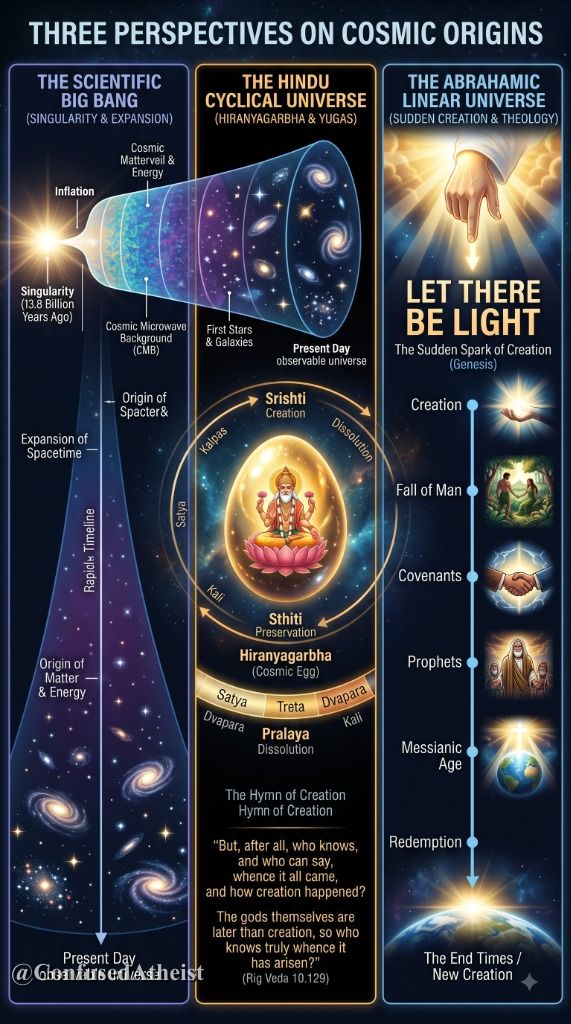
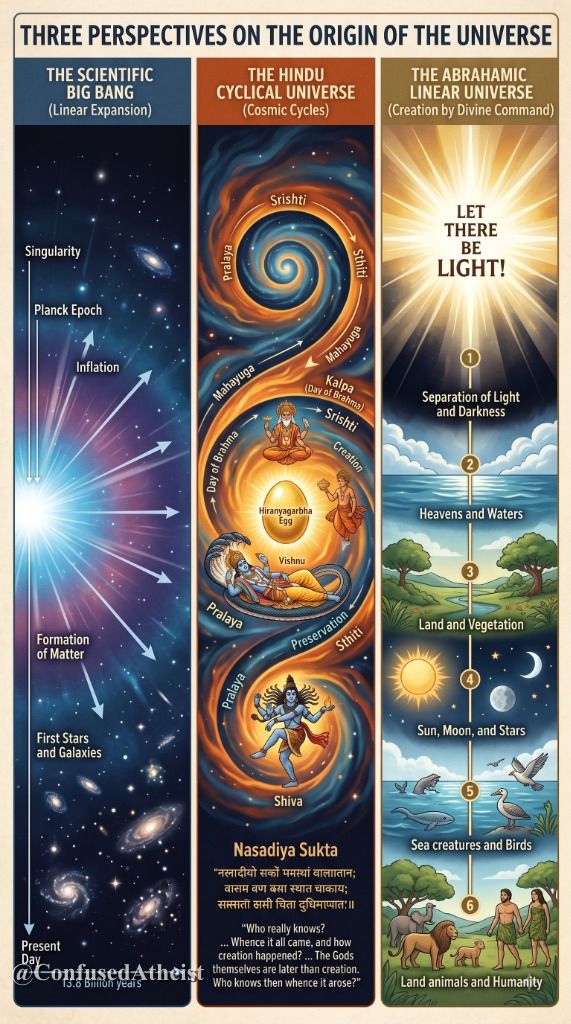
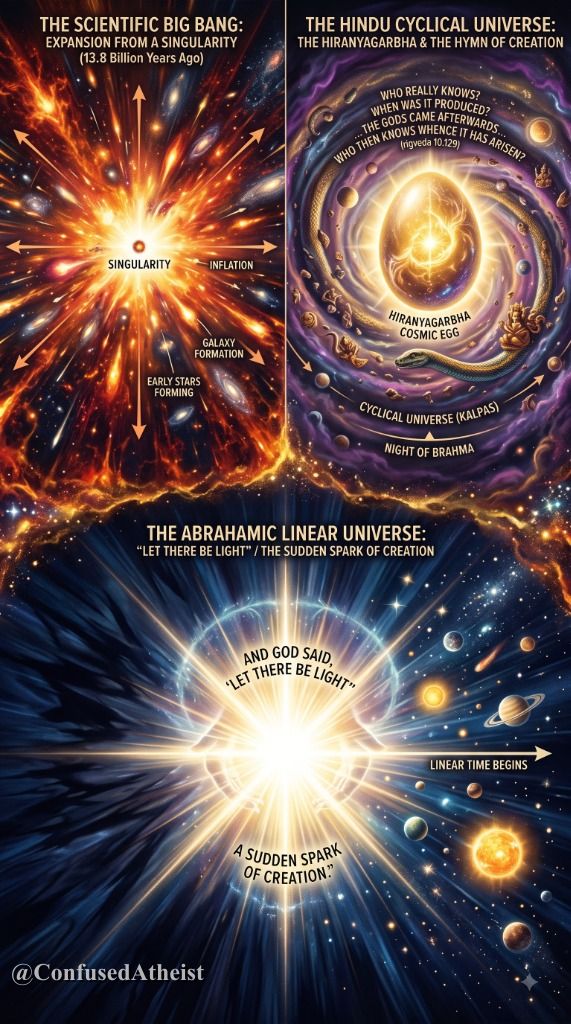
The story
In Hindu cosmology, the universe didn't start with a gradual evolution; it hatched from a Hiranyagarbha—a "Golden Womb" or Cosmic Egg. Ancient texts describe this egg floating in a void of nothingness until it split open, expanding rapidly to create the heavens and the earth.
The Nasadiya Sukta (the Hymn of Creation in the Rig Veda) asks a question that still haunts modern physicists:
"Then there was neither non-existence nor existence... What was covered in, and where? And what gave shelter? Who really knows? Who will here proclaim it? Whence was it produced? Whence is this creation? The gods came afterwards..."
Even the gods, according to this text, were born after the universe was created. The ultimate source remains an incomprehensible mystery.
Meanwhile, Abrahamic traditions (Judaism, Christianity, Islam) describe a linear beginning. The Book of Genesis starts with a void of darkness, pierced suddenly by the command: "Let there be light."
What the evidence shows
Does an expanding egg of energy floating in the void sound familiar? It bears a poetic resemblance to the modern understanding of the Big Bang singularity expanding into space.
Interestingly, the idea of a sudden "flash of light" starting the universe aligns with the photon epoch of the Big Bang. In fact, it was a Catholic priest and physicist, Georges Lemaître, who first proposed the Big Bang theory in the 1920s, originally referring to it as the "hypothesis of the primeval atom" or the "Cosmic Egg."
Where experts disagree
While the parallels are fascinating, historians and physicists caution against reading modern science into ancient poetry. The "Cosmic Egg" is a common mythological motif found globally (from Greek Orphic traditions to Chinese Pangu myths), representing fertility and birth rather than a literal scientific singularity.
Ancient cosmologies often operated on philosophical or spiritual frameworks rather than empirical observation. Claiming that ancient seers literally "knew" about the Big Bang applies retroactive significance to their poetic metaphors.
What we still don't know
As a skeptic, you don't have to believe that a literal deity snapped the universe into existence. But looking at these ancient myths reveals something profoundly beautiful about humanity.
Both myth and science agree on one terrifying, beautiful concept: Everything we know came from a singular, incomprehensible source of energy. What exactly triggered that initial expansion—and what existed before the Big Bang, if time itself even existed—remains one of the greatest unsolved mysteries in physics.
Sources
- Rig Veda, Mandala 10, Hymn 129 (Nasadiya Sukta). Translated by Ralph T.H. Griffith, 1896.
- Lemaître, Georges. "The Beginning of the World from the Point of View of Quantum Theory." Nature, 1931.
- Hawking, Stephen. A Brief History of Time. Bantam Books, 1988.
Evidence Labels
More like this
How Did the Indus Valley Map the Stars 4,000 Years Ago?
Harappan cities were aligned to the cardinal directions long before magnetic compasses. What do street grids and steatite seals reveal about their astronomy?
The Lost River Saraswati: Did a Mighty River Vanish Beneath the Desert?
Rigvedic hymns praise a roaring Saraswati River, while satellite imagery reveals dried paleochannels under the Thar Desert. What does the geology show?