Navratri Day 6: Maa Katyayani, the Incarnate Wrath Born to Slay the Shapeshifter
On the sixth night of Navratri, the cosmic struggle reaches a decisive flashpoint. Maa Katyayani is the ultimate warrior manifestation of the Goddess—born not from biological parenthood, but crystallized out of the collective outrage and concentrated energy (Tejas) of the gods to accomplish what an entire pantheon of male deities could not: the destruction of the buffalo demon Mahishasura.
The story
According to the Devi Mahatmya (Markandeya Purana), the demon king Mahishasura had obtained an arrogant boon from Brahma: no god, man, or beast could cause his death. Believing himself entirely invincible, he routed the divine hosts, occupied Svarga (heaven), and established a reign of terror across the cosmos.
Dispossessed and humiliated, the gods led by Brahma, Vishnu, and Shiva gathered in intense distress. As their collective indignation peaked, a blinding pillar of fiery energy burst from the faces of the assembled deities.
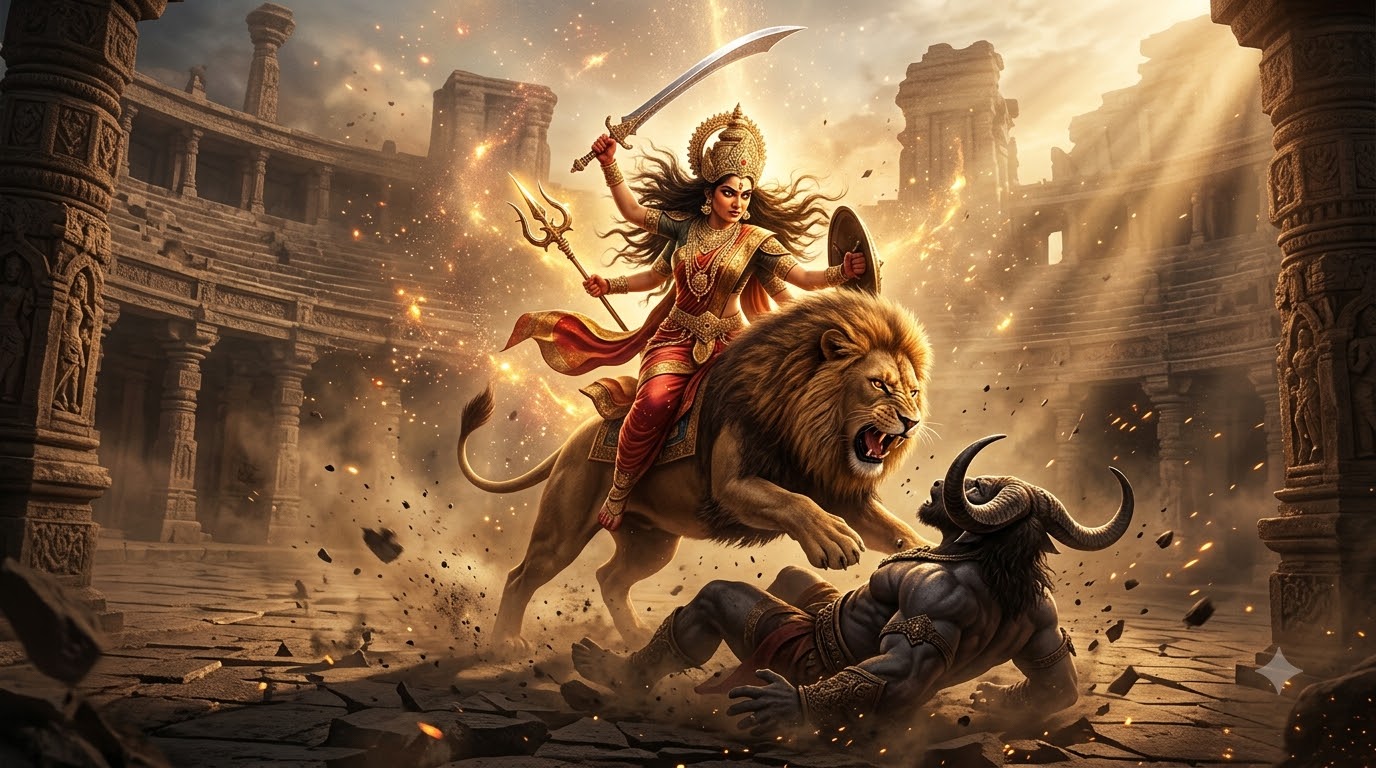
This unified celestial light converged at the hermitage of Sage Katyayana, where it condensed into the radiant, golden form of a warrior maiden. Because the sage was the first to recognize and venerate her, she became known as Katyayani.
The gods outfitted her with their most devastating weapons: Shiva bestowed his trident, Vishnu his discus, Varuna his conch, Agni his spear, Vayu his bow and quiver of arrows, Indra his thunderbolt and bell, and Himavat a magnificent golden lion. Marching to Mount Vindhya, she confronted Mahishasura, parrying his deceptive animal transformations before pinning the shape-shifter beneath her foot and severing his neck with her flashing sword, Chandrahasa.
चन्द्रहासोज्ज्वलकरा शार्दूलवरवाहना।
कात्यायनी शुभं दद्याद्देवी दानवघातिनी॥

Translation: Holding the flashing sword Chandrahasa in her hand, mounted upon the noble king of beasts, may Goddess Katyayani, slayer of the demonic hordes, grant victory, clarity, and protection.
Iconography and philosophical symbolism
Katyayani’s iconography embodies absolute determination, focused anger, and uncompromising justice:
- The Sword Chandrahasa: Gleaming like the moon, the sword represents piercing intellect and discernment (Viveka). It slices through the shapeshifting illusions (Maya) that obscure true reality.
- The Golden Complexion: Her radiant gold hue signifies the pure fire of truth (Tejas) that incinerates the darkness of ignorance.
- The Golden Lion Mount: Unlike the calm lion of Skandamata, Katyayani’s lion is aggressive, charging directly into combat, symbolizing fearless confrontation with external and internal tyranny.
- Abhaya and Varada Mudras: Even amidst ferocious warfare, her lower hands remain open, granting fearlessness and boons to the righteous, proving that her wrath is not vindictive, but restorative.
- Ajna Chakra: She presides over the Third Eye Chakra (Ajna), situated between the eyebrows. This is the command center of intuition, concentration, and clarity. Slaying Mahishasura represents the victory of laser-focused consciousness over base, stubborn animal instincts.
What the evidence shows
Textual and historical analysis indicates that Katyayani is one of the earliest documented names of the pan-Indian warrior goddess.
Her name appears in ancient Vedic and Upanishadic layers, such as the Taittiriya Aranyaka (10.1.7), alongside the names Durgi and Kanyakumari. Historians note that Katyayani reflects the fusion of a historical Gotra-based sage lineage (the Katya clan) with indigenous martial goddesses of the Vindhya mountain range (often referenced as Vindhyavasini). This reveals how regional tribal warrior cults were synthesized into the classical epic literature during the Gupta era.
Where experts disagree
Scholars debate the psychological and sociopolitical meaning of Mahishasura's defeat. While devotional traditions celebrate the triumph of good over evil, critical historians explore the sociological subtext: Mahishasura (associated with the water buffalo, Mahisha) has been analyzed by some subaltern scholars as an ancient indigenous or pastoral chieftain whose conquest was mythologized as the triumph of agrarian settlement over pastoralist borderlands.
Conversely, Shakta philosophers maintain that the buffalo—an animal prone to charging blindly in fits of rage and wallowing in stagnant mud—was chosen as an enduring psychological metaphor for ignorance, stubbornness, and uncontrolled ego.
What we still don't know
Archaeologists continue to search for the definitive origin of the Mahishasuramardini iconographic type. While Kushan-era terracotta plaques from Mathura and Rajasthan (circa 1st–2nd century CE) depict early forms of a multi-armed goddess subduing a buffalo, the specific textual attribution to Katyayani in stone inscriptions remains rare until the 6th century CE.
Sources
- Coburn, Thomas B. Devi Mahatmya: The Crystallization of the Goddess Tradition. Motilal Banarsidass, 1988.
- Kinsley, David. Hindu Goddesses: Visions of the Divine Feminine in the Hindu Religious Tradition. University of California Press, 1988.
- Agrawala, V. S. Devi-Mahatmyam: The Glorification of the Great Goddess. All-India Kashiraj Trust, 1963.
Evidence Labels
More like this
Navratri Day 5: Maa Skandamata, the Maternal Sovereign of the War God
The fifth night of Navratri honors Skandamata: the four-armed protector holding infant Kartikeya on her lap, uniting tender maternal love with martial vigilance.
Navratri Day 7: Maa Kalaratri, the Midnight Void and the Dissolution of Fear
The seventh night of Navratri honors Kalaratri: the ferocious destroyer of darkness who rides a donkey and dissolves the terror of mortality and time.
Maa Durga and the Nine Avatars: Symbolism of the Divine Feminine
An exploration of the Navadurga, the warrior goddess archetype, and her triumph over Mahishasura.