Navratri Day 5: Maa Skandamata, the Maternal Sovereign of the War God
On the fifth night of Navratri, the divine narrative shifts toward the archetype of the protective mother. Maa Skandamata—literally the "Mother of Skanda"—is celebrated as the divine parent of Lord Kartikeya (also known as Murugan or Kumara), the supreme commander of the celestial armies who destroyed the tyrannical demon Tarakasura.
The story
According to the Kumarasambhava of Kalidasa and the Skanda Purana, the demon Tarakasura had secured a seemingly foolproof boon from Brahma: he could only be slain by a son born of Lord Shiva. Because Shiva was immersed in ascetic detachment following Sati’s death, Tarakasura believed himself immortal, unleashing widespread devastation across the three realms.
When Parvati successfully concluded her millennia of tapasya and wed Shiva, their combined fiery energies gave rise to a child of extraordinary radiance: Skanda.
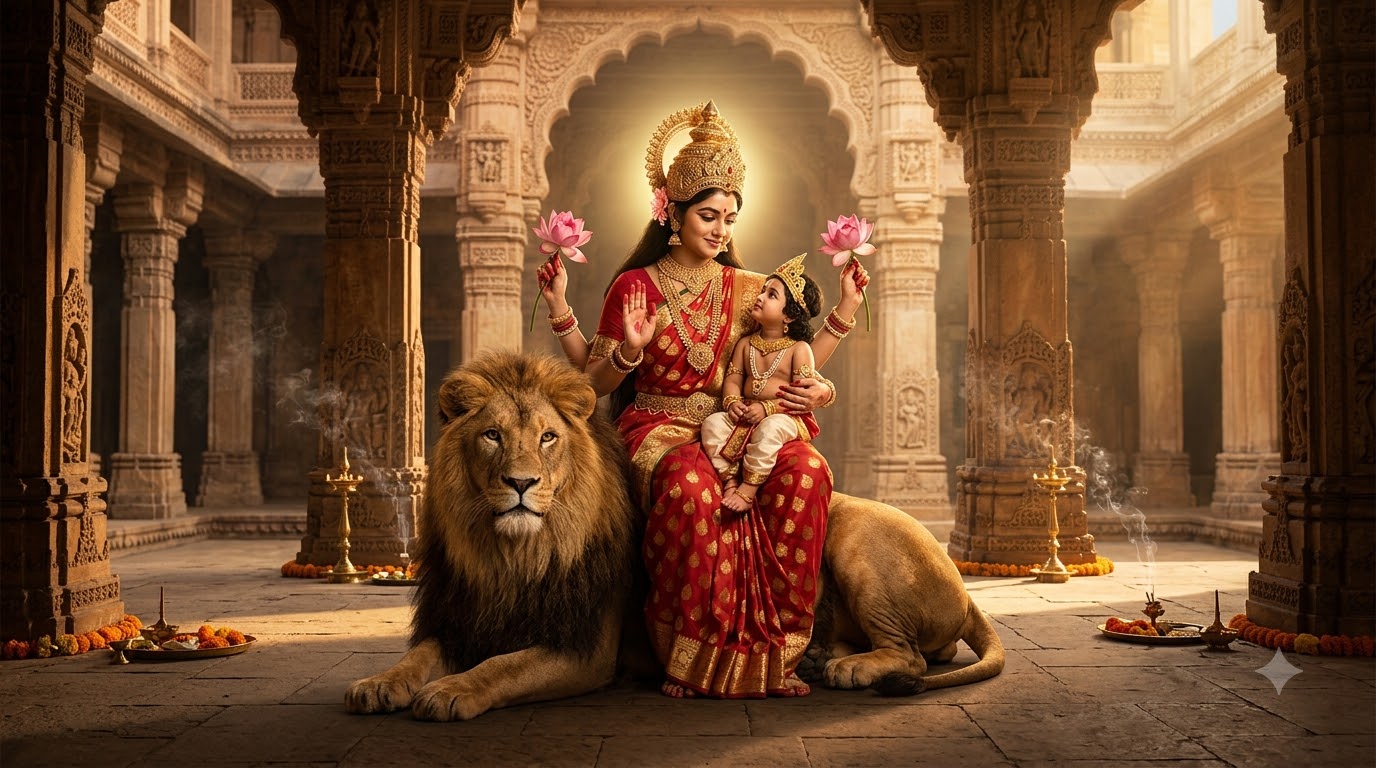
As an infant, Skanda was nurtured by the Krittikas (the Pleiades star cluster) and trained under the vigilant eye of his mother. When the time came to lead the celestial hosts into battle against Tarakasura's demon hordes, it was the mother's blessing that fortified the young general. By worshiping Skandamata, devotees simultaneously worship the infant war god seated upon her lap, honoring the maternal source of righteous martial strength.
सिंहासनगता नित्यं पद्माञ्चितकरद्वया।
शुभदास्तु सदा देवी स्कन्दमाता यशस्विनी॥

Translation: Eternally seated upon a throne, her hands graced with blooming lotuses, may the illustrious Goddess Skandamata, mother of the celestial commander, always grant victory and auspiciousness.
Iconography and philosophical symbolism
Skandamata’s iconography beautifully weaves the apparent contradiction between maternal tenderness and martial ferocity:
- Infant Skanda in Lap: Her lower right hand supports the infant war god, who is depicted with six faces (Sanmukha) or as a radiant child holding a spear (Vel). This illustrates that the fiercest warriors are nurtured in the sanctuary of maternal wisdom.
- The Roaring Lion Mount: While the goddess’s facial expression is calm and maternal, she is mounted upon a ferocious, battle-ready lion. This contrast signifies that maternal love is never passive; when provoked, protective maternal instinct is deadlier than any weapon.
- Twin Blooming Lotuses: In her two upper hands, she holds raised lotus blossoms, earning her the name Padmasana Devi ("Goddess seated upon the lotus"), signifying spiritual purity and emotional transcendence.
- Abhaya Mudra: Her lower left hand is raised in the gesture of fearlessness, promising protection to those who uphold righteous action (Dharma).
- Vishuddha Chakra: She governs the Throat Chakra (Vishuddha), the energetic hub of authentic voice, creative expression, and discernment. Purification of this chakra allows one to articulate truth without fear.
What the evidence shows
From an anthropological and regional perspective, the iconography of Skandamata reflects the historical synthesis of northern Puranic Shaivism with the deeply rooted southern cult of Murugan.
In ancient Tamil Sangam literature (such as the Tirumurukarruppatai and Paripatal), Murugan is an indigenous Dravidian deity of war, youth, and mountainous landscapes. Over the classical and early medieval eras, northern Sanskrit literature integrated Murugan into the Shaiva pantheon as Skanda or Kartikeya, while celebrating the Goddess as his primordial mother, successfully harmonizing diverse regional religious traditions across the subcontinent.
Where experts disagree
Historians and mythologists examine the power dynamics encoded in the Skandamata depiction. Feminist scholars point out that unlike classical patriarchal depictions where female characters derive legitimacy solely from their husbands or fathers, Skandamata is defined through her child—a dynamic that nevertheless elevates her as the sovereign protector whose sanction validates the male warrior's authority.
Conversely, some structuralist scholars argue that the emphasis on motherhood in Day 5 served a stabilizing social function in early medieval India, reinforcing idealized maternal duty (Matritva) amidst political instability and military conflicts.
What we still don't know
The precise archaeological timeline for when the iconographic type of the mother holding a child on a lion emerged in stone remains debated. Early Kushan and Gupta terracottas depict various mother goddesses (Matrikas) holding infants, but distinguishing specific Skandamata icons from general Matrika figures without clear inscriptions remains challenging for art historians.
Sources
- Kinsley, David. Hindu Goddesses: Visions of the Divine Feminine in the Hindu Religious Tradition. University of California Press, 1988.
- Clothey, Fred W. The Many Faces of Murukan: The History and Meaning of a South Indian God. Mouton, 1978.
- Kale, M. R. (Ed. & Trans.). The Kumarasambhava of Kalidasa. Motilal Banarsidass, 1981.
Evidence Labels
More like this
Navratri Day 4: Maa Kushmanda & Adi Shakti, the Primordial Smile that Ignited Creation
Worshipped on Chaturthi, Maa Kushmanda is the primordial solar demiurge who dispelled cosmic darkness with a gentle smile, birthing the Hiranyagarbha.
Navratri Day 6: Maa Katyayani, the Incarnate Wrath Born to Slay the Shapeshifter
The sixth night of Navratri honors Katyayani: the warrior born from the collective fury of the gods, brandishing the flashing sword Chandrahasa to defeat Mahishasura.