The Descent of Ganga: Was It an Ancient Mega-Engineering Project?
A River in the Heavens
Long ago, Ganga flowed only in the heavens. She was a celestial river, pure and radiant, belonging to the realm of the gods. Earth had no share of her. Yet it was Earth that needed her most, and the story of how she came down begins with a great royal family and an unfinished duty.
King Sagara and His Sixty Thousand Sons
King Sagara of the Ikshvaku dynasty, an ancestor of Lord Rama, performed the Ashwamedha yagna, the great horse sacrifice. The sacrificial horse was let loose to roam freely, guarded by his sixty thousand sons. Indra, fearful of losing his throne, stole the horse and hid it in the ashram of the sage Kapila, who was deep in meditation in the netherworld, Patala.
The sons of Sagara dug through the earth in search of the horse. They found it beside the meditating sage, wrongly assumed he was the thief, and stormed at him with insults. Kapila opened his eyes, and the fire of his gaze reduced all sixty thousand princes to ashes.
Their souls were left restless and without liberation, because no proper last rites had been performed. The scriptures said that only the waters of the heavenly Ganga, touching their ashes, could free them.
Three Generations of Devotion
Sagara's grandson Anshuman tried to bring Ganga down and failed. His son Dilipa tried and failed too. Then Dilipa's son, Bhagiratha, took up the task. He handed his kingdom to his ministers and went to the Himalayas to perform tapasya, a penance so severe and so long that the heavens themselves took notice.
Pleased at last, Lord Brahma appeared and granted the boon: Ganga would descend to Earth. But he also gave a warning that would shape the rest of the story.
The Problem: A Force Too Great
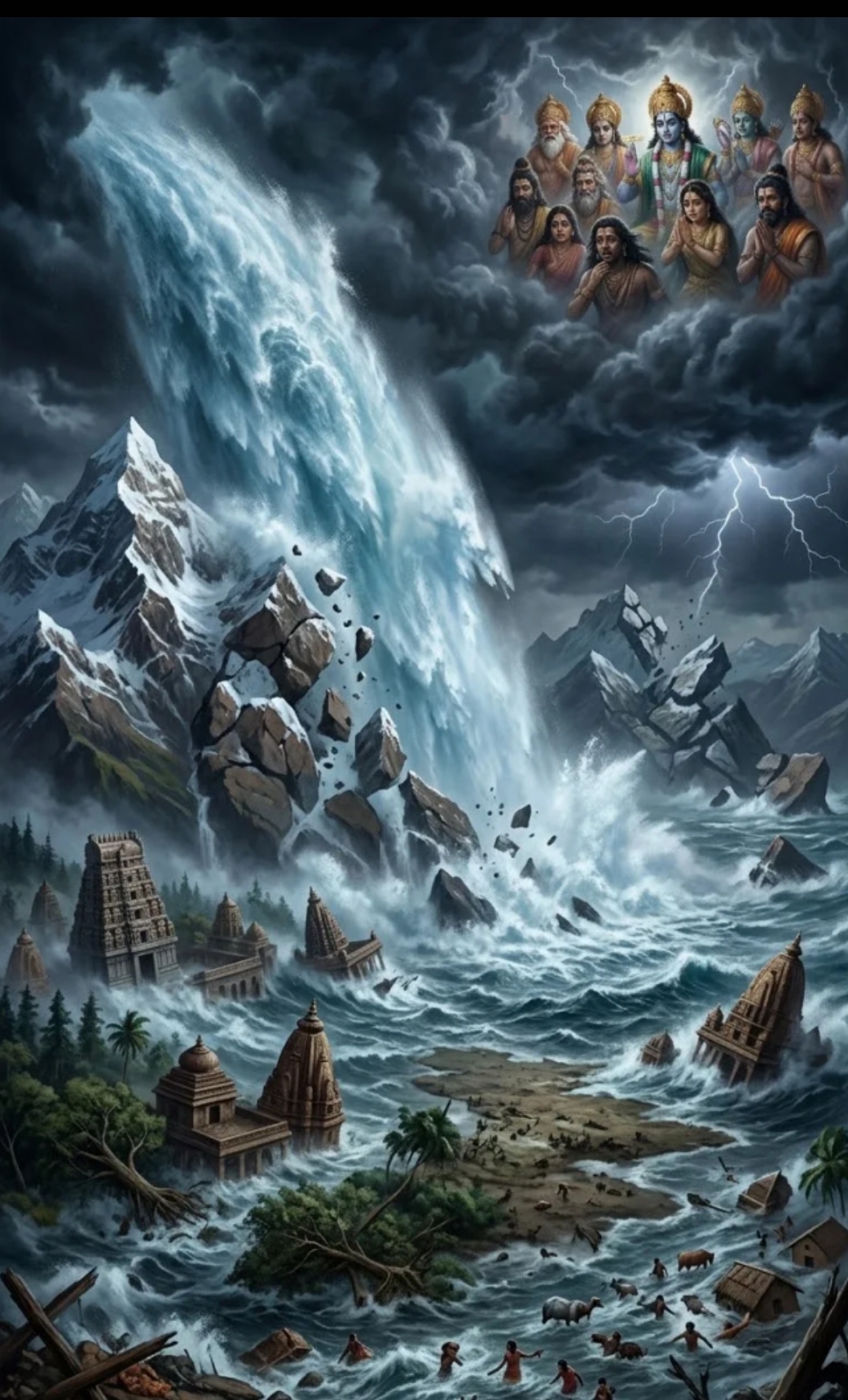
Brahma told Bhagiratha that Ganga's descent from the heavens would be no gentle rain. She was a river of the sky, and she would fall with unimaginable power. If she crashed straight onto the Earth, the ground would shatter under the impact. The mountains would crumble, the plains would be swept away, and the very Earth would be unable to bear her.
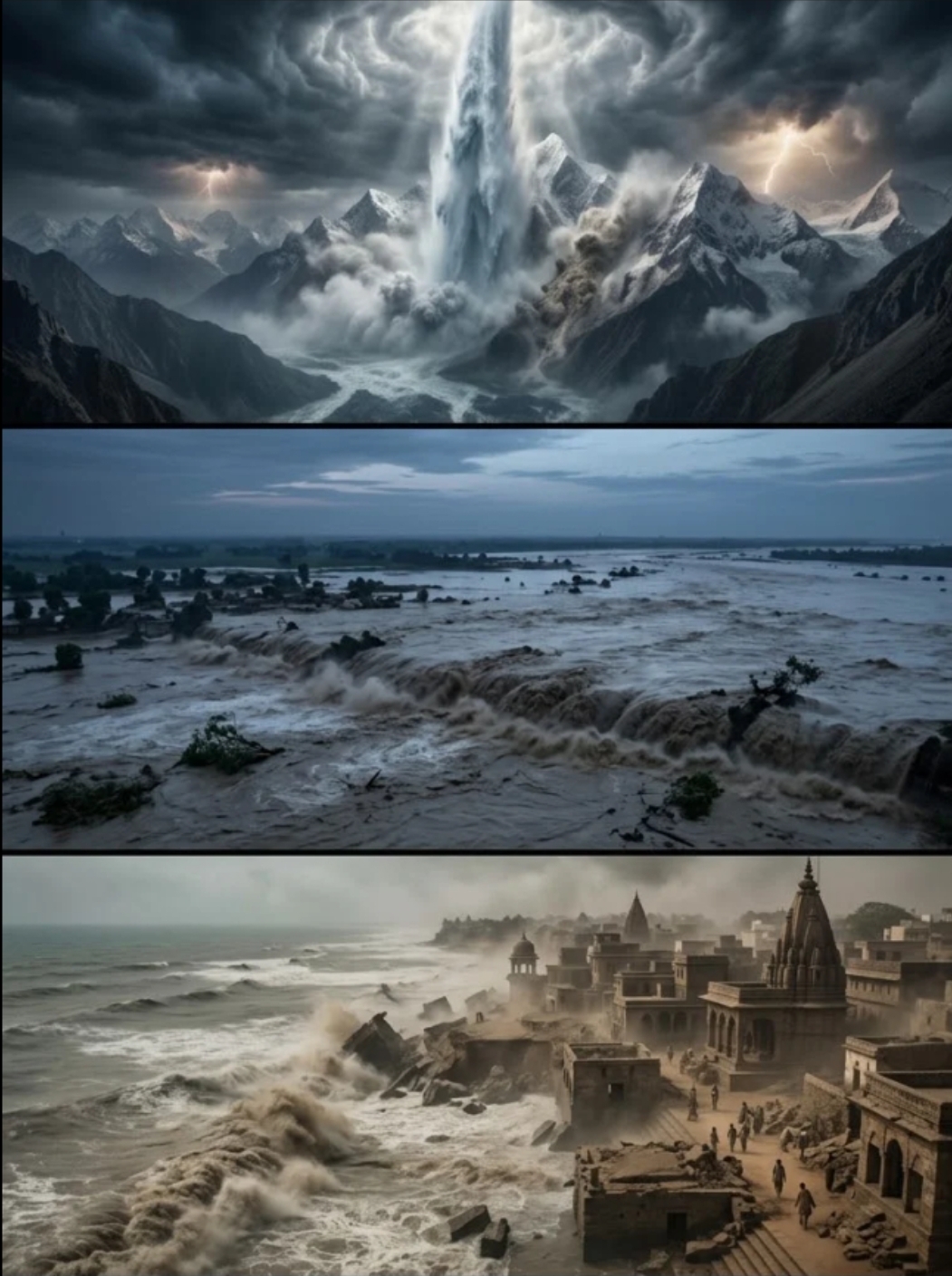
Left unchecked, Ganga would not have been a blessing. She would have been a catastrophe. The very river meant to bring life and liberation would have destroyed the world that was waiting for her.
Only One Could Bear Her
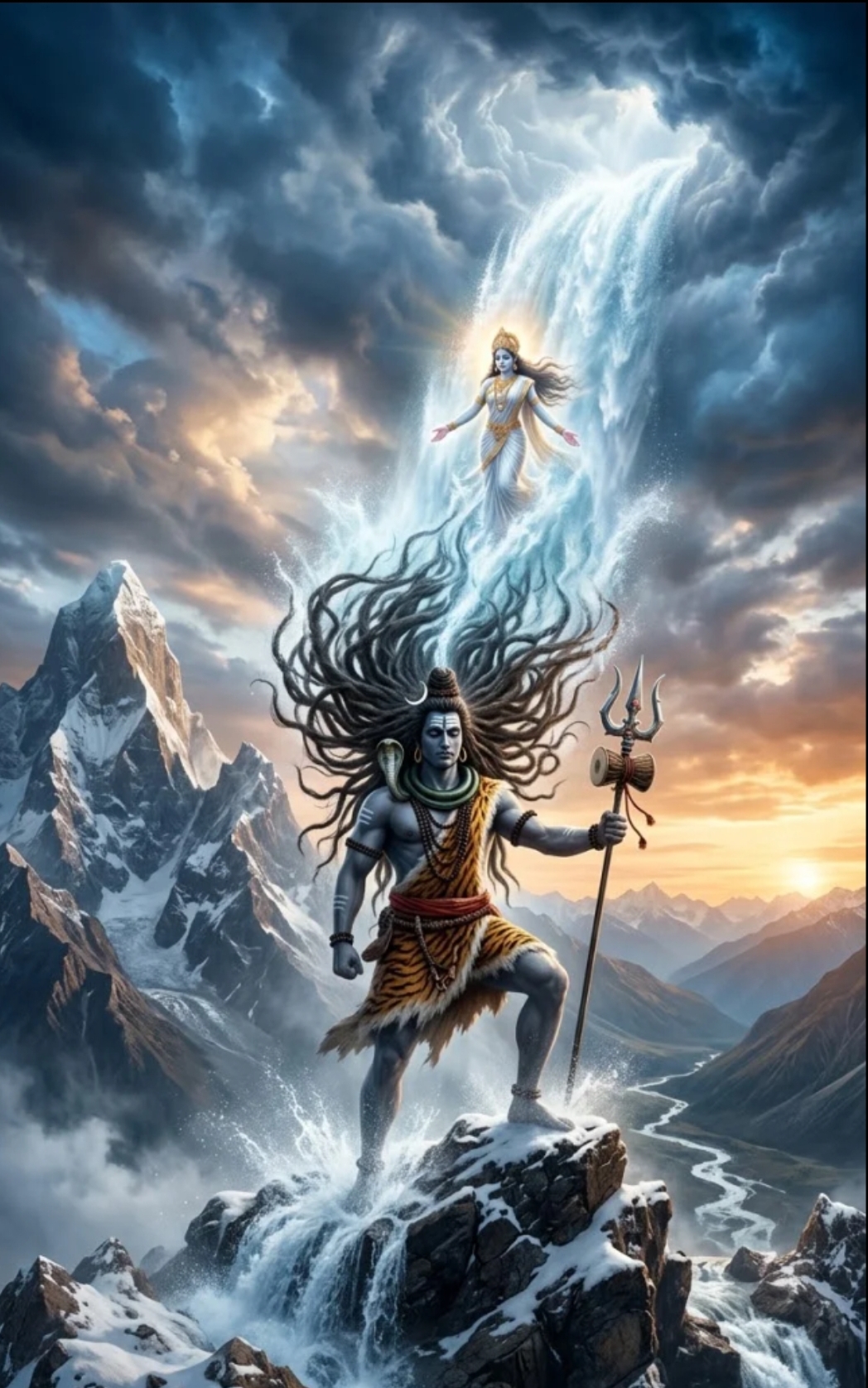
Brahma told Bhagiratha that there was only one being in all creation who could receive Ganga's fall: Lord Shiva, Mahadeva, the master of the mountains and the supreme yogi. No mountain, no ocean, and no other god could withstand her force.
So Bhagiratha began again. He stood on one foot for a full year, praying to Shiva. Moved by his devotion, Shiva agreed to catch Ganga on his head.
Ganga's Pride and Shiva's Jata
When the moment came, Ganga rushed down from the heavens with tremendous force. In some tellings, she was proud of her power and thought she would sweep Shiva away and carry him into the depths of Patala.
Shiva understood her thoughts. He stood calm and unmoving on the Himalayan heights, and as she fell he caught her in his thick, matted locks, the jata. Mighty Ganga, who could have shattered the Earth, was lost within his hair. She wandered there for years, unable to find her way out, and her pride was gone.
The Gentle Release
Bhagiratha, seeing that Ganga had vanished into Shiva's hair, prayed to him again. Shiva relented and let her out in gentle streams from the jata, no longer a destructive deluge but a life-giving river. Some traditions say she was released in seven streams. Her strength had been softened, and her humility restored.
Bhagiratha led the way on his chariot and Ganga followed behind. On the way she flooded the ashram of the sage Jahnu, who drank up her waters in irritation. After further prayers he released her again from his ear, and this is why Ganga is also called Jahnavi. Finally she reached Patala, touched the ashes of the sixty thousand sons of Sagara, and set their souls free. Because of Bhagiratha's great effort, she is also known as Bhagirathi, and a task that demands supreme effort is still called a "Bhagiratha prayatna."
Why Shiva's Jata Mattered for the Planet
The story holds a lesson that goes well beyond one family's liberation. Power in itself is not the gift; power that is tempered and directed is.
The mountains stand between the sky and the plains, and Shiva's locks stand between Ganga's heavenly force and the Earth.
Held in the jata, Ganga's fall was broken. She was slowed, divided into streams, and released gradually. That is why she could flow across the land, feeding fields, filling wells, and giving water to countless cities, villages, and forests along her banks, instead of tearing the land apart.
Many people also see in the jata an image of the Himalayas themselves, whose glaciers and high forests catch the torrential waters of the monsoon and let them go steadily down into the great rivers of the plains.
Ganga came down for the salvation of souls, but her gentle arrival also gave the Earth a lifeline that has sustained civilizations for thousands of years. Shiva's role was to protect the world from her force so that it could receive her blessing.
Har Har Mahadev - Jai Ganga Maiya
Sources
- Valmiki Ramayana, Balakanda, Sargas 38–44 (The legend of Bhagiratha and the descent of Ganga).
- Eck, Diana L. India: A Sacred Geography. Harmony Books, 2012.
Evidence Labels
More like this
The Lost River Saraswati: Did a Mighty River Vanish Beneath the Desert?
Rigvedic hymns praise a roaring Saraswati River, while satellite imagery reveals dried paleochannels under the Thar Desert. What does the geology show?
The Submerged Stones of Dwarka: What Lies Beneath the Water?
Archaeologists found submerged stone walls and anchors off Dwarka. How much connects to the epic legend of Krishna’s sunken city?