The Meta-Protest: Demonstrating Against the Right to Protest
Satire / opinion, not factual reporting. AI-assisted, for curiosity, not authority.
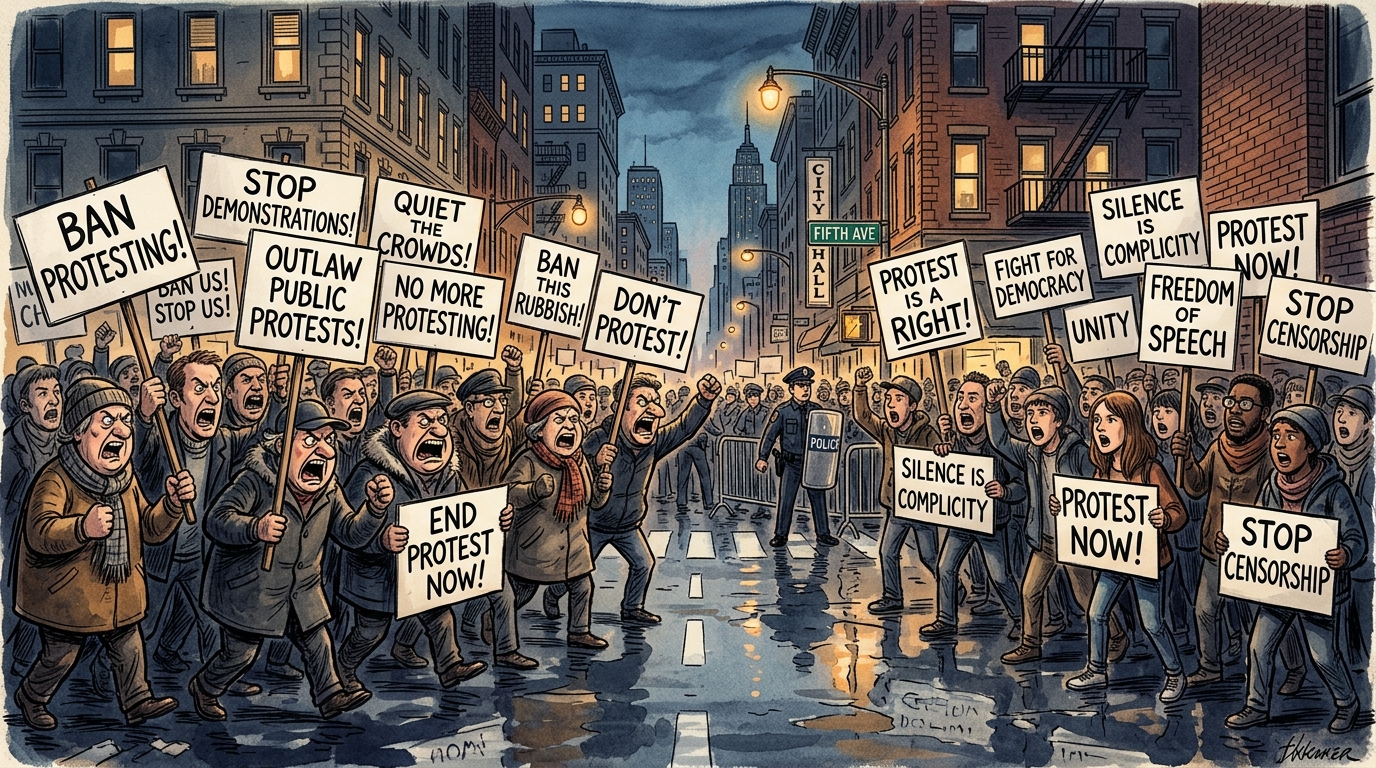
There is a distinct, dizzying threshold of modern civil discourse where political satire ceases to be an artistic genre and simply becomes the evening news. We crossed that threshold recently when a group of furious citizens gathered in the middle of a bustling metropolitan boulevard, unpacked folding chairs, unfurled professionally printed vinyl banners, seized megaphones, and began passionately chanting against the concept of public demonstrations.
They had assembled to demand an end to assembling. They were marching to condemn walking in groups. They were causing a three-mile traffic bottleneck to complain that people who cause traffic bottlenecks should be locked up.
Welcome to the Meta-Protest: the recursive, self-consuming uroboros of twenty-first-century indignation.
The Mathematics of Recursive Grievance
In classical logic, there is a famous paradox named after Bertrand Russell regarding the barber who shaves only those men in town who do not shave themselves. The question is: does the barber shave himself? If he does, he shouldn't; if he doesn't, he must.
Modern political outrage has managed to implement Russell’s Paradox on asphalt.
Consider the logistical gymnastics required to organize a meta-protest. You must wake up at dawn, print placards bearing slogans like "Silence the Noise!" and "Outlaw Public Rallies!", coordinate carpools on WhatsApp, apply for a municipal assembly permit, and occupy a public park for six consecutive hours. At no point during the banner-ordering process does anyone look across the kitchen table and murmur: "Wait... aren't we doing the exact thing we are yelling at them for doing?"
The answer, of course, is no. Because in the theatre of modern polarization, their demonstration is an intolerable obstruction of civic order, whereas our demonstration is an indispensable restoration of common sense. When others block an intersection, it is economic sabotage; when we block the exact same intersection with lawn chairs and patriotic brass bands, it is sacred civic therapy.
The Illusion of the Quiet Citizen
The driving myth behind the meta-protest is the romantic archetype of the "Silent Majority." The narrative goes like this: there is an immense, tranquil sea of hardworking citizens who just want to commute in peace, mow their lawns, and watch sports without having slogans shouted into their car windows.
Yet, the moment this supposed "silent" majority gets annoyed enough, they do not remain silent. They buy a 100-watt PA system, hire a DJ, print bumper stickers, and turn Fifth Avenue into a shouting match.
The tragic irony is that silence cannot be defended by decibels. You cannot scream someone into serenity. By stepping onto the asphalt to protest the existence of protestors, the anti-protestor instantly forfeits their only claim to moral superiority: the fact that they were at home minding their own business.
Nagarjuna and the Tetralemma of Rage
Ancient Indian philosophy anticipated this kind of cognitive vertigo millennia ago. The Buddhist logician Nagarjuna developed the Catuskoti (the four-fold negation), arguing that dogmatic assertions inevitably collapse under the weight of their own self-contradictions:
- A thing is.
- A thing is not.
- A thing both is and is not.
- A thing neither is nor is not.
The meta-protest occupies all four corners simultaneously. It is a protest that denies protest; it uses the First Amendment to demand the suspension of the First Amendment; it disrupts society to demand an end to disruptions; and it leaves the bewildered commuter sitting in traffic, neither able to move forward nor able to decipher who is screaming at whom.
In classical Athens, the philosopher Diogenes the Cynic used to carry a lit lantern through the marketplace in broad daylight, claiming he was searching for an honest man. If Diogenes were alive today, he would need to carry a set of noise-canceling headphones through the city center, searching for someone who understands irony.
When Irony Finally Eats Itself
Where does the cycle terminate? If history and Internet culture teach us anything, it is that outrage never de-escalates; it merely adds another layer of abstraction.
Inevitably, next week there will be a counter-meta-protest: citizens rallying against the people who rallied against the people who were originally protesting. And three months from now, sociologists will gather on the sidewalk to protest the media coverage of the counter-meta-protest.
Until then, we are left with the defining image of our civic era: a man standing on a barricade with a megaphone turned up to maximum volume, screaming his lungs out to demand that everyone else shut up.